the worst seven months of my life
[math The short and sweet of this is that I tried to apply a cool method (the entropy method) to a problem (chvatals conjecture) that it could never work on. Specifically, Chvatal’s conjecture is a local statement (there exists a maximal star), but my early formulations of the entropy method gave global gaurentees over all maximal intersecting families.
However, I realized much of my approach needed to be fixed…
There are ~3 issues. Starting in reverse order of severity, I have a function that I was unable to formally show was decreasing.
UPDATE: MY PROFESSOR (Prof. Mary Wooters) FOUND THAT FOR SUFFICIENTLY LARGE $s, u$, THIS FUNCTION IS ACTUALLY INCREASING NEAR THE END OF THE INTERVAL:
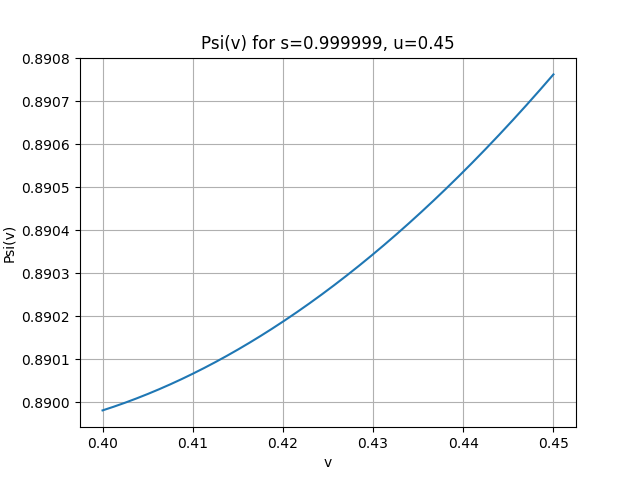
THIS WAS COMPUTED USING PYTHON AND DECIMALS DUE TO ACCURACY CONCERNS WITH THE BINARY ENTROPY FUNCTION, BUT IT SEEMS TO BE INCREASING.
FOR CLARITY HERE IS THE ORIGINAL PROBLEM: Specifically, let $s \in (0,1),$ let $r=\frac{1-\sqrt{s^2-s+1}}{s} <0.5$. Fix $u\in (r, 1/2).$ Write $T_1(v) = v + sv - sv^2$ and $T_2(v) = v + s - sv$. We define $\Psi(v) = \frac{(1-u)\,H(T_1(v)) + (u-v)\,H(T_2(v))}{(1-v)\,H(v)}$ where $H$ is the binary entropy function and $v \in (r, u].$ The goal is to prove that this function is decreasing on the interval.
I BELIEVE THIS IS FIXABLE SINCE $u$ IS UP TO US, SO SOLVING FOR $u$ SUCH THAT THE FUNCTION IS ONE AND THEN CHOOSING THE SMALLER SO THE FUNCTION STAYS DECREASING WOULD STILL ALLOW THIS TO WORK, BUT THE OTHER ISSUES IN THE PAPER ARE STILL LOOMING.
The second issue has to do with the formulation of $s$-uniformity. I believe this condition to be so strong and so limiting that the only possible downsets that admit $s>0$ must have generators that already heavily overlap. Say that we have the generators $1, 2, 3$ and $3,4,5.$ This has 0 uniformity because seeing the presence of $2, 4$ in the first and second set respectively force the conditional probability to go to $0.$
Finally, the biggest issue has to do with my thinning argument. To apply the original Gilmer method, you need the induction to hold all the way through, which is why I have an adaptive way of combining the randomly sampled sets. However, the probabilities $p_i, q_i,$ are dependent on conditioning if our sets could be within a generator or not, so we don’t actually have a way of combining our algebra together.
I spent maybe in total a few weeks of deep focus on this paper on and off for the course of 7 months, which makes it deeply embarrassing how much I failed to understand probability. I imagine that much of this was simply getting used to the analysis that Sawin was doing, and I did appreciate learning more about the analytical combinatorics.
In this sense, I have tried out something new and learned. So I have not yet wasted my time.
The most important questions of life are indeed, for the most part, really only problems of probability. Probability theory is nothing but common sense reduced to calculation.
Laplace, Pierre Simon. Théorie Analytique des Probabilités, 1812, berkeley quotes